Evaluating anisotropy-based Monin–Obukhov similarity theory over canopies and complex terrain
Published:Recommended citation: Waterman, Tyler S., Stiperski, Ivana, Chaney, Nathaniel, Calaf, Marc (2026). Evaluating anisotropy-based Monin–Obukhov similarity theory over canopies and complex terrain. Quarterly Journal of the Royal Meteorological Society, n/a, e70206 https://doi.org/10.1002/qj.70206
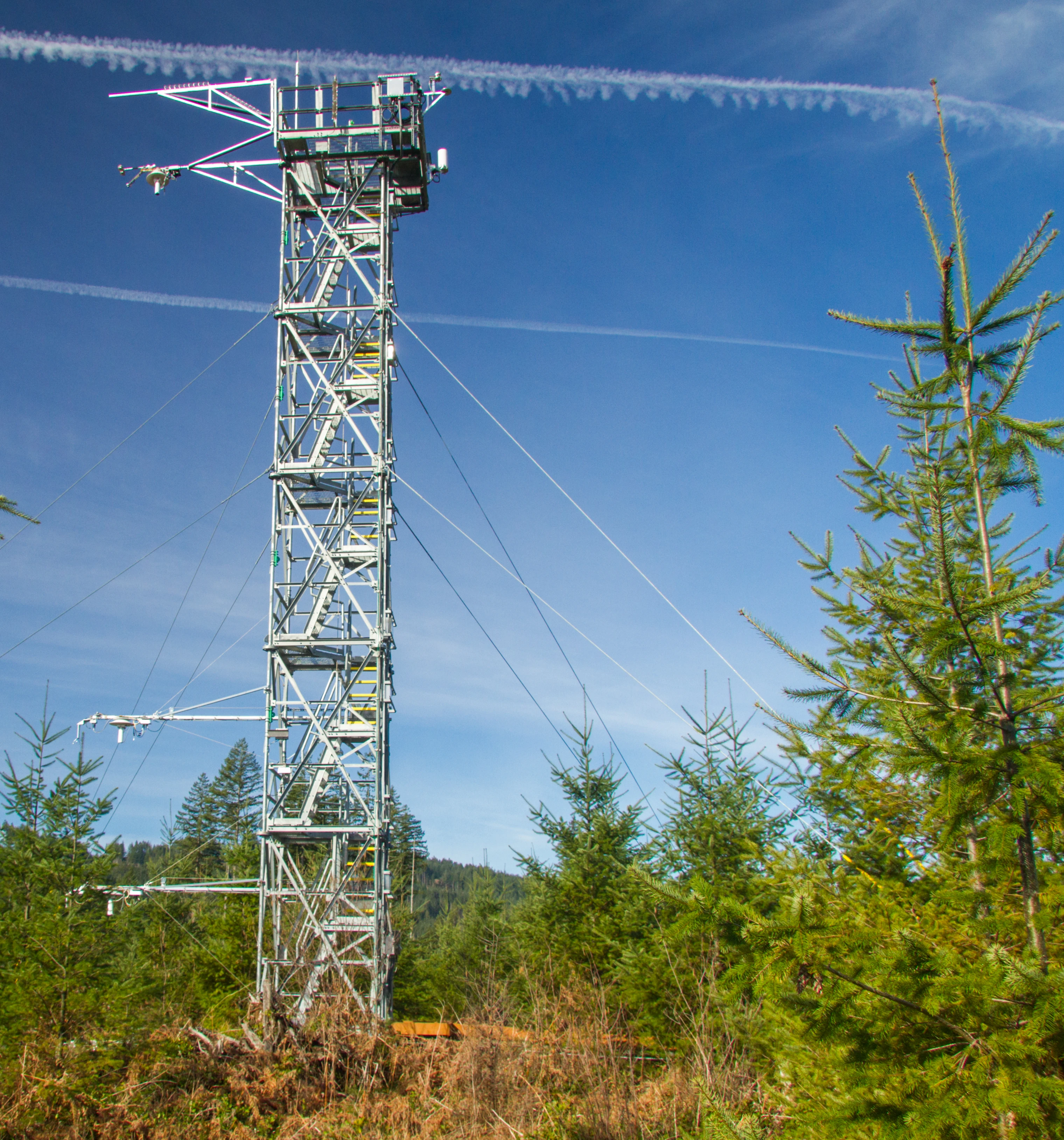
Abstract Monin–Obukhov similarity theory (MOST) has long served as the basis for parameterizations of turbulence exchange between the surface and the atmospheric boundary layer in models for weather and climate prediction. Decades of research, however, have illuminated some of the limitations of MOST-based surface-layer parameterizations, particularly when MOST’s foundational assumptions of flat and horizontally homogeneous terrain are violated. Recent work has leveraged the anisotropy of turbulence as an additional non-dimensional term to extend and generalize MOST to complex terrain. In this work, we examine the performance of this generalized MOST for the scaling of velocity variances, refit these scalings, and study key characteristics of turbulence anisotropy across the 47 towers in the wide-ranging National Ecological Observation Network (NEON). NEON in particular covers a diverse selection of ecosystems, from the Arctic circle to tropical islands, and as such expands the previous generalized MOST to vegetated canopies and other environments not examined in previous studies. The work finds that anisotropy-generalized MOST extends readily to these new environments, with robust performance across seasons over a wide range of canopy and terrain configurations. Results also illuminate velocity variance scaling further across degrees and forms (one-component/two-component) of anisotropy, relate the degree of anisotropy to key environmental characteristics, and evaluate scaling differences between canopies and non-vegetated surfaces across atmospheric conditions, seasons, and the diurnal cycle. Overall, this study expands our understanding of the complexity of turbulence, while paving the way for improved surface-layer parameterizations.